
WAIT — Your Order Is Processing. Do Not Close This Page
This offer disappears the moment you leave
You Just Bought The System.
Here’s What Makes It Work 10X
25 Copy-Paste AI Prompts That Run Every Framework In The Starving Crowd Guide For You — So You Execute Today Instead Of Intending To Execute Someday
From the desk of Carl Galletti
Good. You made the right call getting the Starving Crowd guide.
Halbert drilled this into me for years — the market is everything. Not the copy. Not the offer. The market. Pick the right one and mediocre copy sells. Pick the wrong one and brilliant copy dies. You now have the system that tells you which is which before you spend a dollar on anything.
So the foundation is solid.
But I want to show you something that separates the people who actually use a system like this from the much larger group who buy it, understand it, and then… don’t quite get to it.
And I want to show you right now, on this page, because what I’m about to offer disappears when you leave. This isn’t available on the site. It was built specifically for people who just bought the guide, and it has no standalone purpose. So it only exists here.
Here’s What Actually Happens To Most Buyers Of Systems Like This One
Ninety percent of people who buy a research framework genuinely understand it after reading it.
That’s not the problem.
The problem is there’s a gap between understanding something and executing it — and in that gap, most of the value quietly disappears. Not because the system is wrong. Not because the person is lazy or careless. But because translating a framework you understand into the specific steps you actually need to take is its own separate skill. One that takes real time to develop.
I’ve watched this pattern play out thousands of times across thirty years of teaching this material to serious people. They get the logic completely. They still struggle to move fast on it.
And here’s where it gets specific to you.
Most People Who Try To Use AI For This Research Get Useless Output. Here’s Why.
You’re probably going to use an AI tool to run some of this research. Claude, ChatGPT, Gemini — makes complete sense. AI can analyze Amazon review patterns in twenty minutes that used to take days. It can pull emotional language from fifty Reddit posts while you drink your coffee. For the kind of market research the guide describes, it’s genuinely powerful.
But here’s what I saw when I watched a group of my own students try to use AI on these specific frameworks.
The quality of what you get back has almost nothing to do with which AI tool you’re using.
It comes down to the prompt.
Specific, structured, framework-accurate prompts produce remarkable output. Vague, improvised prompts produce the kind of generic text that could apply to any market on earth and therefore tells you nothing useful about yours.
“Here are some opportunities in your niche to consider.” “This market has both strengths and challenges.” That kind of slop.
Most people’s prompts fall into the second category. Not because they’re careless — because writing a prompt that accurately translates a specific research framework into structured AI instructions is genuinely hard to do well. Especially the first time. Especially when you’re also trying to learn the underlying system at the same time.
So there’s the gap. Between understanding the framework and prompting the AI to actually run it correctly.
What if you could run every single research method in the Starving Crowd guide today — without writing a single prompt from scratch?
Introducing The Starving Crowd AI Prompt Library
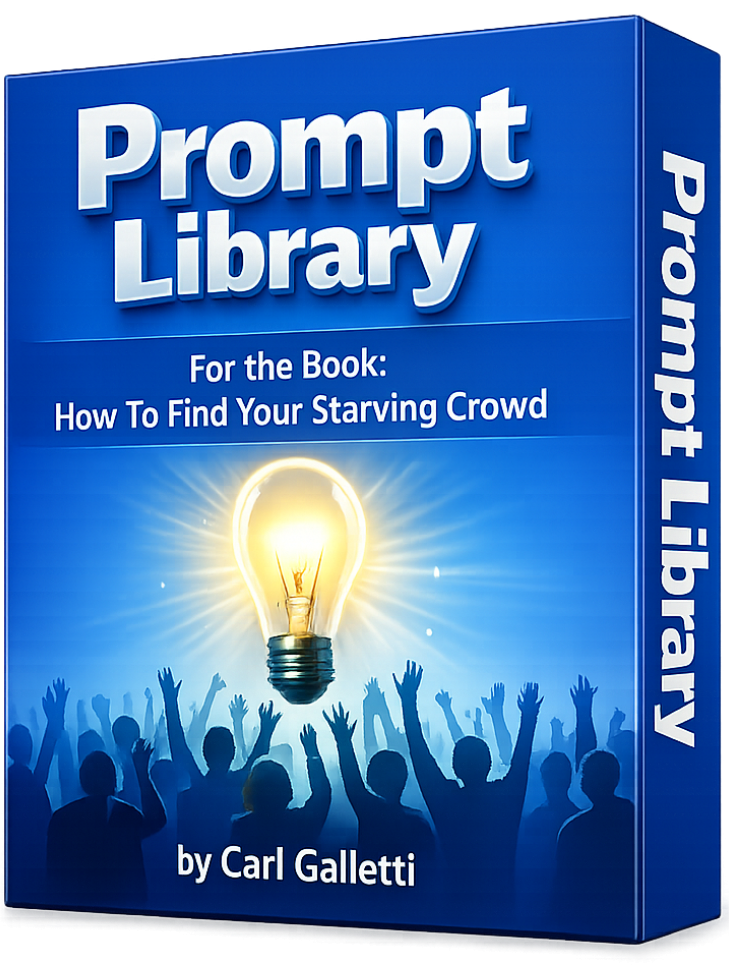
A PDF. Twenty-five complete, copy-paste ready prompts.
One for each major method and framework in the guide — organized by chapter, matched precisely to the system you just bought, with a brief explanation before each one so you know exactly when to use it and what to fill in.
You don’t write anything from scratch. You don’t spend an afternoon trying to reverse-engineer how to get your AI tool to do what the research method actually requires.
You open the PDF. You copy the prompt. You paste it into whatever AI tool you use. You fill in your specific information where the brackets indicate. You hit enter.
The AI runs the framework. You get output you can act on.
That’s the whole thing. No complicated setup. No learning curve on top of the learning curve you’re already navigating.
[PROOF SECTION — SPECIFIC PROMPTS]
Let Me Show You Three Specific Prompts From The Library
Because I don’t want this to feel abstract. Here’s exactly what you’re getting.
Prompt #1: The Four Signs Checklist Prompt
This is built on the core evaluation framework from Chapter 2 — scoring any market on pain level, purchasing power, reachability, and growth trajectory.
When most people try to apply that framework without a structured prompt, they end up with a vague impression of whether their market “seems decent.” Gut feel dressed up as analysis.
This prompt changes that completely.
You describe your market — who they are, what you know about their spending, how you plan to reach them — and the AI scores it systematically. Zero to twenty-five points on each of the four signs, with specific reasoning for every score it assigns. You get a total out of a hundred, a clear verdict on whether the market is worth pursuing, and a diagnosis of your single biggest vulnerability.
That’s a go/no-go decision. With the reasoning laid out in front of you.
Prompt #2: The Community Complaint Extractor
This one might be the most immediately valuable prompt in the entire library.
Here’s the situation it solves. You’ve been in Reddit threads and Facebook groups related to your niche. You’ve got a dozen browser tabs open, screenshots, copied posts. You know there’s gold in there — real buyer language, real frustrations, real failed solutions — but it’s raw. You can feel the pattern without quite seeing it clearly enough to use it.
You paste that raw community content into this prompt. What comes back is five things, with real precision:
Every repeating problem, ranked from most to least frequent. The exact emotional phrases people use — the specific words they actually reach for, not your guesses about what they probably feel. Every solution they’ve already tried that didn’t deliver (which is the single most useful thing for positioning a new product, because now you know what not to be). Their direct statements of what success looks like to them in their own words. And a one-paragraph Starving Crowd Summary — who these people are, what they’re in pain about, what they’ve already tried, what they want more than anything.
That summary paragraph is your entire market positioning in one piece of text. Built from real buyer words.
Prompt #3: The Complete Starving Crowd Profile Builder
This is the one you run after you’ve done your research across all five tools. You put everything you’ve gathered into this prompt — your Amazon data, your keyword data, your community research, your ClickBank findings. All of it.
What comes back is a complete buyer profile. Pain stack from most to least urgent. Failed attempts — everything they’ve bought or tried that didn’t work. Dream outcome described in specific terms, not vague ones. Buying behavior. Where they already spend money, at what price points, who they already trust.
And at the very end of the output — one sentence. A headline or email subject line designed to stop the exact right buyer and make them feel like you’ve been reading their private thoughts.
That sentence is the starting point for everything else you write. The prompt produces it in one pass.
Those are three of the twenty-five. Every major framework in the guide has its own dedicated prompt in the library, built to run that specific method accurately.
Why $17 Is Almost Low Enough To Be Embarrassing
Let me be straight about the number.
Good prompt engineers who specialize in research workflows charge fifty to a hundred and fifty dollars an hour. A properly structured prompt that accurately mirrors a complex research framework takes more than an hour to build from scratch — because you have to iterate through the versions that produce generic output before you land on the version that produces specific, useful output. Across twenty-five prompts, the cost to hire that out would be a serious number.
Or you do it yourself. Which isn’t impossible. But the first several attempts at each prompt won’t work the way you want them to. You’ll know because the output will feel like it could apply to anyone. Getting to a finished, reliable prompt takes real time.
Seventeen dollars gets you the tested, finished version of all twenty-five. Today.
And here’s the framing that matters most.
One bad market choice — the exact mistake the Starving Crowd system is designed to prevent — costs you more than a hundred times seventeen dollars in time, ad spend, and momentum you don’t get back. The prompt library is what makes the guide actually prevent that mistake instead of being something you read, meant to act on, and eventually set aside.
One Thing You Should Know About This Page
This is the only place this exists.
It’s not on the site. There’s no way to come back for it tomorrow. This is available specifically to people who just bought the Starving Crowd guide, at this moment, because it was built to work alongside that exact system.
When you close this page, this offer closes with it.
That’s not a sales line. It’s just the structure of how this works.
30-Day Full Refund. No Questions.
Open the library. Run the prompts. If the output isn’t worth seventeen dollars to you — genuinely, if you use these and come away thinking that was a bad trade — email me. Full refund. You keep the PDF.
I’m not worried about that.
Here’s What To Do Right Now
Click the button below. It adds the Starving Crowd AI Prompt Library to your existing order. Your guide and the prompt library both delivered together, right now, as a single download.
Twenty-five prompts. Copy-paste ready. Every framework from the guide, ready to run today.
Seventeen dollars.
Regular Price: $197 | Today Only: $17 | Available on This Page Only
P.S. The thing that kills more good intentions than anything else in this business is the gap between “I understand how to do this” and “I actually did this.” The prompt library closes that gap. Thirty years of watching people work through this material and the pattern never really changes. The ones who move fast are the ones who have the exact next action in front of them. For seventeen dollars that’s what this is — the exact next action, twenty-five times over, ready to paste.
P.P.S. This page will not be here after you leave it. If you want the library, now is when you get it.
© 2026 Carl Galletti